
Hermes Agent / Field Notes
I’m Christopher Sherrod. I help people use Nous Research’s Hermes Agent in real-world workflows. I run it at home myself and share what works, what breaks, and what still needs a human.
The point isn’t more time with AI. It’s more time for the rest of life.
This is a working journal, not a product pitch. I want to know whether the time saved is worth the maintenance.
See what I’m building · Read the field notes · Contact me about your workflow
Have a workflow in mind?
If you’re trying to make Hermes Agent useful in your own work, contact me with the task you’d like it to handle. We can look at what’s worth automating, where a person should review the result, and whether the system actually saves you time.
A practical place to start
My Markdown CRM shows the kind of work I mean: portable notes about people and follow-ups, with optional AI-assisted drafts that stay in a human review queue. It’s a practical project, not a claim that the whole AI system is finished. The field notes below include other perspectives while I document more of the home-server work.
Why I’m building an independent AI system
Software is supposed to save us time. Too often, we end up managing subscriptions, connecting apps, copying information between them, and repeating the same small tasks every day.
I’d rather have a small system that does useful work on my behalf—and that I can understand, maintain, and change when I need to.
Independent doesn’t mean I run every AI model locally or refuse paid services. It means I aim to control the workflow, keep my information portable where possible, and avoid becoming dependent on any one vendor.
AI is useful when it gives us back time and attention. Otherwise, it’s just another hobby that looks like productivity.
What I’m building
A home-server AI assistant
Status: Running foundation
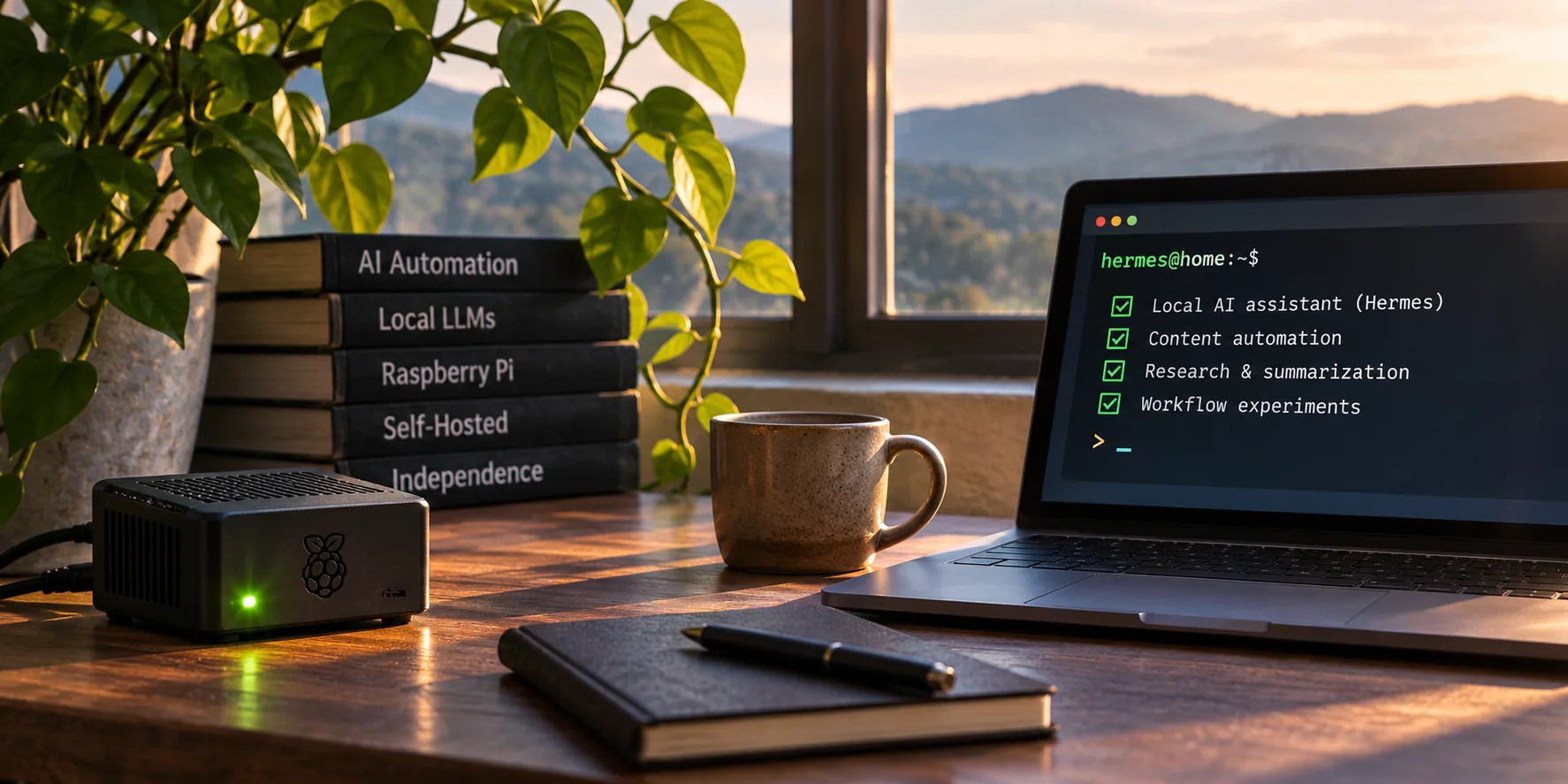
I run a Hermes-based assistant on a Raspberry Pi at home. It gives me a system I can configure and maintain, rather than making one hosted AI product the center of everything I do.
Scheduled, repeatable work
Status: Running and being refined
I’ve set up recurring jobs so repetitive tasks can start on a schedule instead of waiting for me to remember them. The next challenge is making their results reliable, easy to check, and recoverable when something fails.
Specialized agents with clear responsibilities
Status: Experimental
I’m testing distinct roles for research, editing, publishing, and coordination. I’m more interested in useful handoffs and human review than in pretending an AI team can run a business without oversight.
Practical business integrations
Status: Work in progress
Websites, publishing, email, and administration all create repetitive work. I’m exploring ways to connect the systems I already use, automate the parts that are predictable, and keep judgment and approvals with a person.
These are experiments in different stages—not four finished products. I’ll distinguish dependable workflows from promising prototypes as I document them.
One practical lesson so far
Getting a job to run on a schedule is the easy part. Making sure it produces something useful, can be checked quickly, and doesn’t create more maintenance is harder.
That’s the standard I’m using: does this system remove meaningful work from my day, or has it simply given me another system to manage?
The principles behind the work
- Useful beats impressive. A small, dependable automation is better than a complicated demo.
- Control matters more than purity. Self-host where it helps; use outside services when they genuinely earn their place.
- Keep a human responsible. Research, publishing, sensitive data, and consequential actions still need judgment and review.
- Prefer portable systems. I want to be able to move my data and replace tools without rebuilding everything.
- More life, not more machinery. Automation should protect time for writing, art, relationships, and living.
Who I am
I’ve spent three decades building websites, working with software, and running businesses. I’ve also seen how easily technology meant to simplify work becomes work of its own.
Today I write about meaningful work, attention, creativity, and living well with technology. Independent AI is one part of that larger question: how do we use powerful tools without letting them take over our days?
Field notes
These are good places to start while I document more of the technical work.
Markdown CRM: A Calm, Plain-Text System
Practical project. A portable relationship-management system with optional AI-assisted drafts, a review queue, and an emphasis on human control.
The AI War Is Already at Your Front Door
Security / Essay. Why AI changes both attacks and defenses—and why the basics still matter.
Harnessing Artificial Intelligence: A Creator’s New Best Friend
Creativity / Earlier essay. How I began using AI to support research, editing, and creative work without giving up human judgment.
I’ll add hands-on notes as the experiments become useful enough to explain. You can also explore my other projects.
Follow the experiments
Start with the field notes for practical projects and essays. If you have a Hermes Agent workflow to talk through, contact me. I also write a newsletter about attention, meaningful work, creativity, and living a fulfilling life. It isn’t an AI-only newsletter, but the same principle runs through it: use technology deliberately, then get on with living.
Less busywork. More life.